CRM vs ERP: What’s the Difference and Which Does Your Business Need?
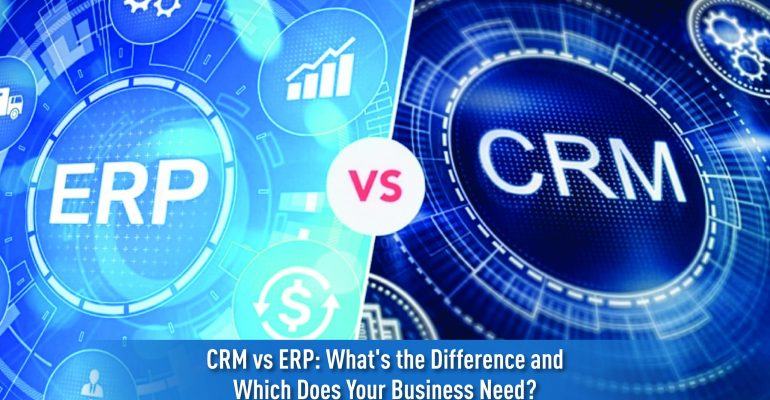
CRM vs ERP: What’s the Difference and Which Does Your Business Need?
Digital transformation is changing how businesses across the UAE manage customers, employees, finances, inventory, sales, and everyday operations. As organisations grow, relying on spreadsheets, disconnected applications, and manual processes can make it difficult to maintain efficiency and access accurate business information.
This is where Customer Relationship Management and Enterprise Resource Planning systems become valuable. While both technologies help businesses improve productivity and decision-making, they serve different purposes. CRM focuses mainly on customers, sales, marketing, and relationship management, while ERP connects internal functions such as finance, inventory, procurement, HR, and operations.
Understanding CRM vs ERP is important before investing in business software. The right solution depends on business size, industry, operational requirements, existing technology, and future growth plans.
What Is CRM?
Customer Relationship Management software helps businesses manage customer interactions throughout the sales and service journey. It provides a centralised platform for storing customer information, tracking leads, managing sales opportunities, recording communications, and monitoring customer relationships.
Instead of keeping customer information across spreadsheets, emails, and different applications, CRM brings important data into one system. Sales teams can track prospects, schedule follow-ups, monitor opportunities, and understand where each lead stands in the sales pipeline.
Marketing teams can use CRM data to improve campaigns and customer engagement, while customer service teams can access customer history to provide more personalised support.
For businesses looking for CRM software in the UAE, the right platform can improve sales visibility, lead management, customer communication, and overall customer experience.
What Is ERP?
Enterprise Resource Planning software takes a broader approach by connecting the internal processes required to operate a business efficiently.
An ERP system can integrate accounting, finance, inventory, procurement, human resources, supply chain management, project management, reporting, and other operational functions into a centralised platform.
For businesses searching for ERP software Dubai, a scalable ERP solution can improve operational control, reduce data duplication, and provide better visibility into overall business performance.
CRM vs ERP: What’s the Difference?
The main difference between CRM and ERP is their focus. CRM is customer-focused, while ERP is organisation-focused. CRM helps businesses attract, convert, retain, and support customers. It is particularly useful for sales, marketing, and customer service teams that need to manage leads, opportunities, communications, and customer information.
ERP focuses on the internal processes and resources required to run the organisation. It can manage finance, accounting, inventory, procurement, HR, supply chains, projects, and operational reporting.
In simple terms, CRM helps a business manage customers and increase sales, while ERP helps a business manage resources and improve operations. Neither system is necessarily better than the other. They solve different business challenges and can work together as part of a connected digital environment.
How Do CRM and ERP Work Together?
CRM and ERP can complement each other when integrated effectively. A sales team can use CRM to capture a lead, communicate with a prospect, manage the opportunity, and convert it into a customer.
Once an order is confirmed, relevant information can move into the ERP system. Finance can manage invoicing, inventory teams can check stock, procurement can handle purchasing, and operations can coordinate fulfilment.
Integrating CRM and ERP can reduce duplicate data entry, minimise errors, improve collaboration, and give management a more complete view of customer and operational performance. For growing businesses, combining both platforms can create a connected business management software environment where customer and operational data work together.
When Does Your Business Need CRM?
CRM is generally suitable for businesses whose main challenges involve sales, marketing, lead generation, customer relationships, or customer service. You may benefit from CRM if your sales team struggles to track enquiries, follow up with prospects, manage customer information, or understand the sales pipeline.
CRM becomes increasingly valuable as a business grows. While spreadsheets may work for a small customer base, managing hundreds or thousands of leads manually can become inefficient and error-prone. With suitable CRM software in the UAE, businesses can centralise customer data, automate routine sales activities, improve follow-ups, and gain better insights into customer behaviour.
When Does Your Business Need ERP?
ERP becomes more valuable when the primary challenges involve internal operations. Businesses managing finance, inventory, procurement, supply chains, employees, projects, or multiple locations can benefit from connecting these processes through one platform.
Without ERP, departments may rely on separate systems and spreadsheets, resulting in duplicated data, reporting delays, manual errors, and limited operational visibility.
A well-implemented ERP platform provides a central source of business information and helps organisations improve coordination and reporting. When selecting ERP software in UAE, businesses should consider scalability, integration capabilities, industry requirements, usability, and future expansion.
Can a Business Use Both CRM and ERP?
Yes. Many businesses can benefit from using both because they address different areas of the organisation. CRM manages customer-facing activities, while ERP supports the internal processes behind those relationships. When integrated, information can move between sales, finance, inventory, procurement, and operations without employees entering the same data repeatedly. This can improve efficiency, reduce errors, strengthen collaboration, and support better decision-making.
CRM focuses on customers, sales, marketing, and relationships, while ERP connects internal processes such as finance, inventory, procurement, HR, and operations. If customer management and sales are your biggest challenges, CRM may be the right starting point. If operational complexity is affecting efficiency, ERP may be more suitable. Businesses with broader requirements may benefit from integrating both.
Build a More Connected Business with Us
Choosing the right business software can make a significant difference to productivity, customer management, and operational efficiency. Whether you need CRM to strengthen your sales and customer relationships, ERP to streamline internal processes, or an integrated solution that connects both, TecSpree can help you identify the right approach for your business. Contact TecSpree at +971 55 664 2353 or email sales@tecspree.com to explore scalable CRM, ERP, integration, and enterprise technology solutions for your organisation.