VoIP vs Traditional Phone Systems: Which Saves UAE Businesses More?
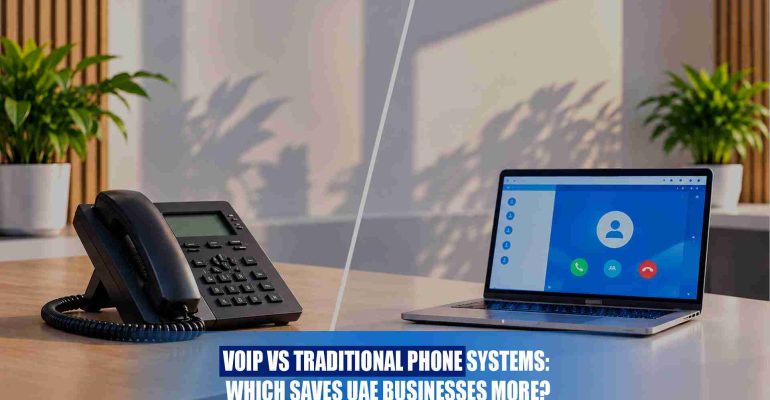
VoIP vs Traditional Phone Systems: Which Saves UAE Businesses More?
Business communication has changed considerably as organisations increasingly rely on cloud applications, remote working, mobile devices and digital collaboration tools. However, business phone systems remain an important part of customer service, sales, internal communication and day-to-day operations.
For UAE businesses, the choice is no longer limited to traditional telephone infrastructure. Voice over Internet Protocol, commonly known as VoIP, provides another approach by using internet connectivity to handle voice communication.
The comparison between VoIP and traditional phone systems involves more than looking at monthly call charges. Businesses also need to consider installation, hardware, maintenance, internet connectivity, scalability, security, features and long-term operating costs.
What Is VoIP?
VoIP is a communication technology that allows voice calls to be transmitted through an internet connection rather than traditional telephone infrastructure.
Depending on the platform, employees may use IP phones, computers, mobile applications or other compatible devices to make and receive business calls. Modern VoIP systems can also provide features such as call routing, voicemail, call queues and integration with business applications.
For businesses considering a VoIP phone system in Dubai, the technology can provide a flexible alternative to conventional telephone systems, particularly where employees work across multiple locations or require remote access.
What Are Traditional Phone Systems?
Traditional business phone systems use conventional telephone infrastructure to provide voice communication. Depending on the system, businesses may use physical telephone lines, dedicated handsets, PBX equipment and related cabling.
These systems have been widely used by businesses for many years and can continue to be suitable where an organisation already has established infrastructure and straightforward communication requirements.
However, expanding or modifying traditional systems can involve physical equipment and infrastructure changes, depending on the setup.
1. Initial Setup Costs
Initial investment is one of the first areas businesses should compare.
Traditional telephone systems may require telephone lines, physical handsets, PBX equipment, cabling and installation. Expanding an existing system may require additional infrastructure depending on the technology being used.
VoIP can use an organisation’s existing network infrastructure, although businesses may still need IP phones, headsets, licences, configuration and installation. The cost of a VoIP phone system in Dubai will depend on the number of users, features, hardware and service model selected.
Businesses should therefore compare the complete installation cost rather than assuming that either technology will always have a lower initial price.
2. Monthly Communication Costs
Traditional systems may involve line rental, call charges, maintenance and other service costs. VoIP providers may instead offer subscription-based plans, bundled calling packages or different pricing structures.
For organisations that make a large number of calls, particularly international calls, the pricing structure can have a significant impact on overall expenditure.
The most useful comparison is therefore the total communication cost over time rather than the price of an individual call.
3. Scalability for Growing Businesses
Business communication requirements often change as an organisation grows. VoIP systems can generally provide greater flexibility for adding users and extensions, depending on the platform and provider.
This can be useful for growing UAE businesses that regularly add employees or operate across multiple offices. Businesses should still check how additional users are priced and what hardware or licences are required before selecting a solution.
4. Remote and Hybrid Working
Remote and hybrid work have changed how employees access business communication systems.
VoIP platforms are designed around network-based communication and can allow employees to access business phone services through supported computers, mobile applications or IP phones. This can make VoIP relevant to businesses with remote employees, travelling staff or teams operating across multiple locations.
However, businesses should evaluate remote access security, mobile support, user authentication and network reliability before implementing the system.
5. Business Phone Features
Modern business communication is about more than making and receiving calls. Depending on the platform, VoIP systems can provide features such as automated attendants, call queues, call forwarding, voicemail, conference calling, call recording, interactive voice response, call analytics and mobile applications.
Integration with CRM and customer service platforms can also help employees manage customer interactions more efficiently.
For businesses evaluating business phone systems in the UAE, comparing the features they actually require is more useful than simply choosing the system with the largest feature list.
6. Maintenance and Administration
VoIP systems also require ongoing management, but many administrative tasks can be handled through software. Depending on the platform, administrators may be able to add users, change extensions, manage call routing and adjust permissions through a central interface.
At the same time, VoIP introduces greater dependence on the organisation’s network and internet connection. Businesses therefore need reliable connectivity and appropriate network configuration to support voice communication.
7. Call Quality and Internet Reliability
Traditional telephone systems generally rely on dedicated telephone infrastructure, while VoIP depends on internet and network performance. High latency, network congestion, packet loss or poor configuration can affect call quality.
Organisations that rely heavily on phone communication may also consider backup internet connectivity to reduce disruption if the primary connection fails.
8. Integration with Business Applications
Application integration is another area where modern VoIP platforms can provide additional functionality. Depending on the solution, a business phone system may integrate with CRM platforms, customer support applications, collaboration tools and other business software.
These integrations can help employees access customer information, manage call records and streamline communication workflows.
9. Security Considerations
VoIP platforms operate through networks and connected devices, making it important to secure user accounts, administrative access, network infrastructure and applications.
Businesses should consider authentication, access controls, software updates, firewall configuration, monitoring and other appropriate security measures. Where supported, encryption can also form part of the security approach.
Security requirements vary between providers and platforms, so businesses should evaluate the controls available before selecting a VoIP solution.
10. International Calling
International communication is particularly relevant for many UAE businesses working with overseas customers, suppliers, partners and employees. Potential VoIP cost savings in the UAE businesses can achieve will depend on their actual usage and the selected service plan. A detailed review of historical call volumes can therefore provide a more realistic basis for comparison.
11. Business Continuity
Communication systems can become particularly important when employees work remotely or when an office experiences a disruption.
VoIP can provide flexibility because users may be able to access communication services from alternative locations and supported devices. Features such as call forwarding can also help redirect calls when necessary.
Businesses should consider backup connectivity, alternative communication methods, backup power, and appropriate call routing as part of their wider business continuity planning.
VoIP vs Traditional Phone Systems: Key Differences
| Factor | VoIP | Traditional Phone Systems |
| Communication | Internet-based | Telephone infrastructure |
| Scalability | Generally flexible | May require additional infrastructure |
| Remote access | Often supported | Depends on system |
| Features | Software-based features | Depends on hardware and system |
| Internet dependency | Yes | Generally lower |
| Application integration | Often available | Depends on system |
| Maintenance | Network and software management | Physical infrastructure and system maintenance |
| International calling | Provider-dependent | Provider-dependent |
| Management | Often centralised | Can involve physical administration |
| Security | Network and account security required | Telephone system security required |
Which System Costs Less?
There is no universal cost advantage for every business. A growing organisation with multiple locations, remote employees, frequent international calls or a requirement for software integration may find that VoIP better matches its communication model.
Businesses should compare installation, hardware, subscriptions, call charges, internet requirements, maintenance, support and upgrades over several years. This provides a clearer picture of the total cost of ownership.
When Should a UAE Business Consider VoIP?
VoIP may be worth evaluating when a business is expanding its workforce, opening additional locations or introducing remote and hybrid working.
It can also be considered by organisations that need flexible user management, advanced call-handling features, CRM integration or software-based communication tools. However, businesses should first confirm that their network infrastructure and internet connectivity can support reliable voice communication.
How Can Businesses Choose the Right Phone System?
Businesses should start by reviewing their current communication costs and requirements. The evaluation should consider the number of users, office locations, international calling volume, remote working requirements, network capacity, required features, application integrations, security controls and support arrangements.
Businesses can then compare the total cost of ownership of both options. Testing the proposed solution before a full rollout can also help identify call-quality, compatibility or user-experience issues.
Build a More Flexible Business Communication Strategy
The choice between VoIP vs traditional phone systems depends on the organisation’s infrastructure, budget, communication requirements, security needs and future plans.
Traditional systems can continue to support businesses with established infrastructure and relatively simple requirements. VoIP can provide a flexible alternative for organisations seeking internet-based communication, remote access, software integration, and different pricing models.
Rather than focusing only on the advertised monthly price, UAE businesses should evaluate the complete cost and functionality of each solution.
Upgrade Your Business Communication with TecSpree
A reliable business phone system UAE should support employees, customers and business operations without creating unnecessary complexity.
TecSpree helps businesses evaluate their IT and communication environments and explore solutions across VoIP, managed IT, cloud, networking, cybersecurity, automation and enterprise technology.
Whether you are considering a VoIP phone system in Dubai, comparing traditional phone systems in the UAE, reviewing potential VoIP cost savings in the UAE, or exploring broader business communication solutions in Dubai, TecSpree can help you assess your requirements and develop a suitable technology strategy.
Reach out to TecSpree at +971 55 664 2353 or email sales@tecspree.com to explore VoIP, managed IT, cloud, networking, cybersecurity, automation, and enterprise technology solutions for your organisation