IT Hardware Procurement Checklist for Dubai Businesses (2026 Edition)
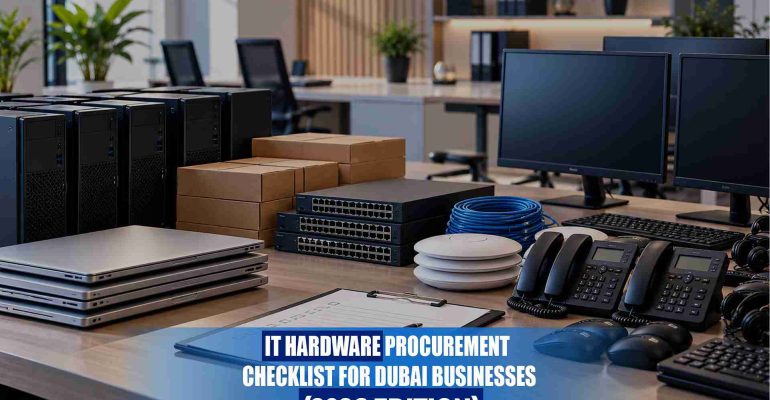
IT Hardware Procurement Checklist for Dubai Businesses (2026 Edition)
Technology hardware is a core part of modern business operations. Laptops, desktop computers, monitors, networking equipment, printers, servers, storage devices and other IT equipment support everything from everyday office work to cloud applications, communication and data management.
For businesses in Dubai, purchasing IT hardware involves more than comparing prices and technical specifications. Organisations also need to consider compatibility, cybersecurity, warranties, scalability, maintenance, employee requirements and the total cost of ownership.
A structured IT hardware procurement checklist can help businesses make better purchasing decisions while reducing unnecessary costs and technology-related disruptions. Whether a company is setting up a new office, replacing outdated equipment, or expanding its workforce, the procurement process should begin with a clear understanding of what the business actually needs.
1. Identify Your Business Requirements
Different employees and departments can have very different technology requirements. An employee working with documents, email and business applications may only need a standard business laptop, while a designer, engineer, developer or video editor may require significantly more processing power, memory and graphics performance.
This prevents two common problems: buying hardware that cannot handle the required workload or spending more on specifications that employees do not actually need.
2. Review Your Existing Hardware Inventory
Before purchasing new equipment, businesses should understand what they already have. A current IT asset inventory can show how many laptops, desktops, monitors, printers, servers, network devices and other assets are in use. It can also record important information such as model numbers, serial numbers, purchase dates, warranty status, assigned users, and expected replacement dates.
For companies planning IT hardware procurement in Dubai, maintaining an accurate inventory also makes future budgeting and replacement planning easier.
3. Set a Realistic Budget
Hardware price is important, but it should not be the only financial consideration.
The actual cost of purchasing IT equipment can include installation, configuration, software, accessories, warranty extensions, maintenance, repairs and eventual replacement. Businesses should therefore consider the total cost rather than focusing exclusively on the initial purchase price. A more expensive device may sometimes provide better value if it offers greater durability, longer support, better performance or a longer useful life.
4. Match Specifications to Workloads
Businesses do not necessarily need the highest specifications available for every employee. Processor performance, RAM, storage, graphics capability, display quality, battery life, and connectivity should be selected according to the user’s workload. The objective is to achieve the right balance between performance and cost rather than automatically purchasing premium hardware.
5. Check Hardware and Software Compatibility
New equipment should integrate with the organisation’s existing technology environment. Before placing an order, businesses should confirm compatibility with operating systems, business applications, cloud platforms, security software, VPN solutions, printers, network infrastructure and other existing systems.
This is particularly important for organisations that still rely on older applications or specialised software. Compatibility problems discovered after purchase can lead to additional configuration costs, delays and productivity issues. Including compatibility checks in an IT procurement checklist can help identify these problems before equipment is ordered.
6. Consider Cybersecurity from the Beginning
Security should be considered during procurement rather than after hardware has been deployed. Business devices can contain customer information, employee records, financial information, credentials and confidential company documents. Hardware should therefore support the organisation’s broader security requirements.
Depending on the business environment, relevant features may include secure boot, TPM support, device encryption capabilities, biometric authentication, firmware security and compatibility with endpoint management and security solutions. Businesses should also have a standard process for securing newly purchased devices before they are assigned to employees.
7. Evaluate Networking Requirements
Employee devices are only one part of a company’s IT infrastructure. Businesses also need reliable networking equipment to connect users, applications, cloud services, printers, security systems and other devices. Routers, switches, wireless access points, firewalls and related infrastructure should be selected based on the organisation’s current and expected requirements.
Businesses should consider the number of users and connected devices, office size, wireless coverage, network traffic and future expansion. A growing company should ideally avoid purchasing networking equipment that will need to be replaced shortly after an expansion.
8. Compare Warranty and Technical Support
Warranty and after-sales support can significantly affect the long-term value of IT equipment. Before purchasing, businesses should understand how long the warranty lasts, whether on-site support is available, how repairs are handled, and how quickly replacement parts or devices can be provided.
When comparing IT equipment suppliers in Dubai, organisations should therefore evaluate support services alongside product pricing. A supplier offering strong after-sales support may provide greater practical value than one offering a lower initial price with limited assistance.
9. Evaluate Suppliers Beyond Price
Businesses may receive multiple quotations for the same category of hardware. However, the cheapest quotation does not necessarily represent the best overall option. Supplier evaluation should consider product availability, delivery times, warranty arrangements, technical expertise, installation services, configuration support and after-sales service.
Businesses should also verify that the supplier can provide the required quantities and models within the expected timeframe.
10. Plan for Business Growth
Hardware should support not only today’s workforce but also the organisation’s expected growth.
A business with 50 employees today may require equipment for significantly more users in the future. Office expansion, new locations, remote working, additional applications and increased storage requirements can all affect hardware needs. Planning ahead can reduce the risk of replacing hardware prematurely and make future procurement more predictable.
Common IT Hardware Procurement Mistakes
Businesses can create unnecessary costs by purchasing hardware without sufficient planning.
Common mistakes include choosing equipment based only on price, ignoring compatibility, purchasing excessive specifications, failing to consider future growth and overlooking warranty conditions.
Another common issue is purchasing equipment without maintaining an asset inventory. Without accurate records, businesses may find it difficult to identify ageing devices, track warranties or plan future replacements. A structured procurement process can help reduce these issues and improve visibility over the organisation’s technology assets.
How Can Dubai Businesses Improve IT Hardware Procurement?
An effective procurement process should begin with requirements assessment and an inventory review. Businesses can then establish specifications, prepare a budget and identify suitable suppliers. Supplier quotations should be compared based on product specifications, warranty, support, delivery and total cost of ownership rather than price alone.
Once equipment is purchased, the business should follow a standard deployment process and update its asset records. Hardware performance and lifecycle requirements can then be reviewed regularly. This approach allows procurement to become a planned business process rather than an emergency response to equipment failures.
Build a Smarter IT Hardware Procurement Strategy
IT hardware affects employee productivity, security, operational efficiency and long-term technology costs. For this reason, businesses should approach procurement as part of their wider IT strategy rather than as a simple purchasing exercise.
The right IT hardware procurement checklist should cover business requirements, specifications, compatibility, cybersecurity, supplier support, warranties, scalability, total cost of ownership and lifecycle management.
For Dubai businesses, a structured approach can make it easier to purchase equipment that supports current operations while remaining suitable for future growth.
Get the Right IT Hardware for Your Business
Choosing the right business IT equipment starts with understanding your organisation’s current infrastructure, employee requirements and future technology plans.
TecSpree helps businesses assess their IT environments and explore practical solutions across IT hardware, managed IT, cybersecurity, cloud, infrastructure, automation and enterprise technology.
Whether you are planning IT hardware procurement Dubai, replacing office equipment, expanding your IT infrastructure or developing a broader procurement strategy, TecSpree can help you evaluate your requirements and identify suitable technology solutions.
Contact us at +971 55 664 2353 or email sales@tecspree.com to explore IT hardware, managed IT, cybersecurity, cloud, infrastructure, automation, and enterprise technology solutions for your organisation.