In-House IT vs Managed IT Services: Which Saves Your Dubai Business More?
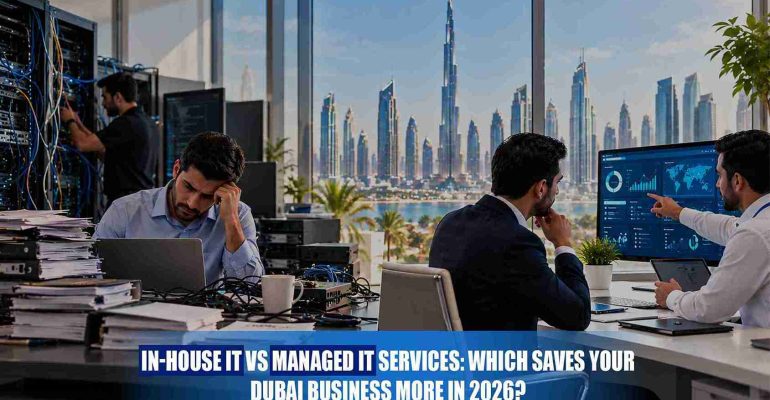
In-House IT vs Managed IT Services: Which Saves Your Dubai Business More?
Technology has become an essential part of everyday business operations in Dubai. From cloud applications and business software to cybersecurity, communication systems and data storage, companies rely on IT infrastructure to keep their teams productive and connected.
There is no single answer for every business. The right approach depends on the organisation’s size, technology requirements, internal expertise, security needs and long-term plans. Cost is also an important consideration, but the actual cost of IT goes beyond employee salaries or monthly service fees.
Understanding the difference between these two models can help Dubai businesses make a more informed decision.
What Is In-House IT?
In-house IT means managing technology internally through employees hired directly by the business. Depending on the size of the organisation, the team may include an IT manager, system administrator, network specialist, helpdesk technician or cybersecurity professional.
An internal team gives a business direct control over its IT environment. Employees can work closely with other departments and develop an understanding of the company’s applications, systems and operational processes.
However, maintaining an in-house team also means taking responsibility for recruitment, salaries, employee benefits, training, equipment and ongoing professional development. Businesses may also need multiple specialists as their technology environment becomes more complex. This can make internal IT more expensive than it initially appears.
What Are Managed IT Services?
Managed IT services involve outsourcing some or all IT responsibilities to an external technology provider. Instead of hiring individual specialists for every requirement, a business works with a provider that delivers IT support and technical services under an agreed service model.
A managed IT provider may support areas such as network management, cloud infrastructure, cybersecurity, system monitoring, backups, helpdesk support, and IT maintenance.
For Dubai businesses, this model can provide access to a broader range of technical expertise without requiring the company to employ a large internal technology team.
Comparing the Real Cost of In-House IT
Businesses also need to consider recruitment costs, employee benefits, training, certifications, hardware, software licences and replacement costs. If an organisation requires specialists in areas such as cybersecurity, cloud computing and networking, it may need to hire several employees rather than relying on one generalist.
If the only IT employee is unavailable due to leave or illness, technical support may be delayed. Businesses may eventually need additional employees to provide adequate coverage.
For organisations operating outside normal office hours or relying heavily on digital systems, providing continuous IT support through an internal team can increase costs further.
Understanding the Cost of Managed IT Services
Managed IT services generally work through a monthly or contracted service model. The cost can vary depending on the number of users, devices, systems and services included.
One advantage is that businesses can define the scope of support according to their requirements. A company may choose a basic IT support package or a broader service covering infrastructure, cloud, cybersecurity, monitoring and backup.
However, businesses should not compare only the monthly managed service fee with an employee’s salary. The more useful comparison is between the total cost of maintaining the required IT capabilities internally and the cost of receiving those capabilities through an external provider.
IT Expertise and Technical Coverage
Technology environments are becoming increasingly specialised. A business may need knowledge of cloud platforms, networks, cybersecurity, Microsoft 365, backup systems, endpoint security and business applications.
A managed IT provider can potentially provide access to specialists across different technology areas. This can be particularly useful for small and medium-sized businesses that cannot justify employing separate specialists for every function.
For companies searching for IT support in Dubai, the ability to access multiple areas of expertise through one provider can be an important consideration.
Which Model Offers Better Scalability?
Business requirements change as organisations grow.
A company opening a new office, adding employees, moving applications to the cloud or implementing new business software may need additional IT support. With an in-house model, this may require recruiting additional employees or expanding the responsibilities of the existing team.
Managed IT services can offer a more flexible approach because support can often be adjusted as business requirements change. The exact flexibility depends on the provider’s service agreement, so businesses should review scalability and pricing before signing a contract.
Cybersecurity Is Another Cost to Consider
Cybersecurity should also be included when comparing in-house IT with managed IT.
Businesses need to protect devices, networks, applications and data against increasingly sophisticated threats. This requires appropriate security tools, monitoring, updates, employee awareness and incident response capabilities.
Building these capabilities internally can require additional specialists and technology investments.
Some managed IT services providers in the UAE combine IT support with cybersecurity services, allowing businesses to manage several technology requirements through one external partner.
However, businesses should carefully review what cybersecurity services are actually included. Basic IT support does not necessarily provide comprehensive security monitoring or incident response.
In-House IT vs Managed IT: A Practical Comparison
| Factor | In-House IT | Managed IT Services |
| Staffing | Direct employees | External IT specialists |
| Cost structure | Salaries and operational costs | Contract or monthly service fees |
| Expertise | Depends on internal team | Access to broader expertise |
| Scalability | May require additional hiring | Can often scale with requirements |
| Support availability | Depends on team size | Depends on agreed service coverage |
| Cybersecurity | Managed internally or separately | Can be included depending on provider |
| Maintenance | Internal responsibility | Provider-managed where included |
| Control | High internal control | Shared through service agreement |
The table shows why the decision should not be based purely on price. Businesses should consider the overall value, coverage and capabilities provided by each model.
When Does In-House IT Make Sense?
An internal IT department can make sense for larger businesses with substantial technology requirements and enough resources to maintain a dedicated team.
It may also be suitable where IT systems are highly specialised or where the organisation needs employees working closely with internal departments every day.
Some businesses may also prefer a hybrid model. They can retain an internal IT team for strategic and operational responsibilities while outsourcing specialised areas such as cybersecurity, cloud management or infrastructure monitoring.
When Can Managed IT Services Be More Practical?
Managed IT can be particularly useful for small and medium-sized businesses that need reliable technical support but do not want to build a large internal department.
It can also help organisations that need access to specialist expertise without hiring multiple full-time employees.
For businesses expanding in Dubai, outsourced IT support can provide additional technical capacity while allowing management to focus on core business activities.
The suitability of managed IT depends on the provider’s capabilities, response times, security practices, service coverage and contractual terms.
How Should Dubai Businesses Choose?
Businesses should begin by calculating their actual IT requirements rather than comparing a single employee salary with a service-provider quotation.
Consider the number of employees and devices, applications being used, cloud infrastructure, cybersecurity requirements, support hours, backup requirements and future growth plans.
Businesses should then calculate the total annual cost of meeting these requirements internally. This should include salaries, recruitment, training, software, hardware, security tools and specialist support.
The same requirements can then be compared with managed IT proposals from suitable providers.
This provides a more realistic picture of the total cost.
Is Managed IT Always Cheaper?
Not necessarily.
For a large organisation with an established IT department and specialised internal requirements, maintaining in-house capabilities may be appropriate. For a smaller company requiring access to multiple technical skills, managed IT may provide broader coverage without the cost of building a large team.
The objective should therefore not be to find the cheapest IT option. Businesses should identify the model that provides the required support, security, expertise and scalability within their available budget.
Choose the Right IT Support Model for Your Business
The decision between in-house IT vs managed IT depends on more than the monthly cost of IT support.
In-house teams provide direct control and dedicated internal expertise, while managed IT services can provide access to wider technical capabilities and scalable support without requiring a large internal workforce.
For many growing businesses, a managed service model can provide a practical way to control IT costs while maintaining access to essential technology expertise. Larger organisations may prefer an internal or hybrid approach based on their operational requirements.
If your business is reviewing managed IT services in Dubai, start by understanding your current technology environment, calculating your total IT costs and identifying the support capabilities you need as your business grows.
Get Reliable IT Support with TecSpree
Managing IT effectively requires more than fixing technical problems when they occur. Businesses need reliable infrastructure, proactive monitoring, cybersecurity, cloud support and a technology strategy that can adapt as operations change.
TecSpree provides businesses with IT support, managed IT, cloud, cybersecurity, infrastructure, automation and enterprise technology solutions tailored to operational requirements.
Whether you are considering IT outsourcing in Dubai, reviewing your existing IT infrastructure or comparing in-house and managed IT models, TecSpree can help you assess your requirements and explore a practical technology approach.
Contact +971 55 664 2353 or email sales@tecspree.com to discuss your business IT requirements.